


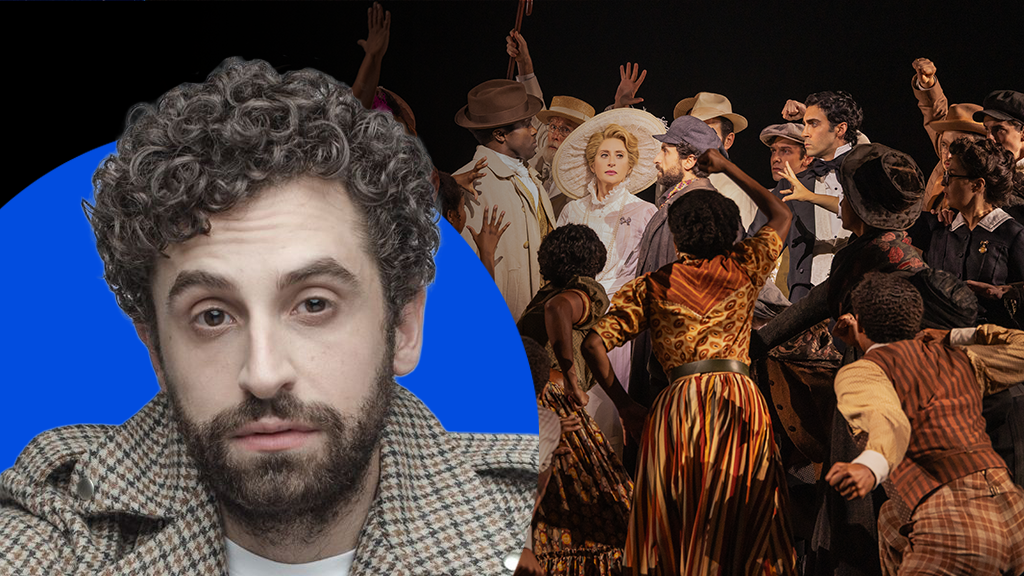
For Brandon Uranowitz, the most powerful art is often focused on asking questions rather than offering answers.
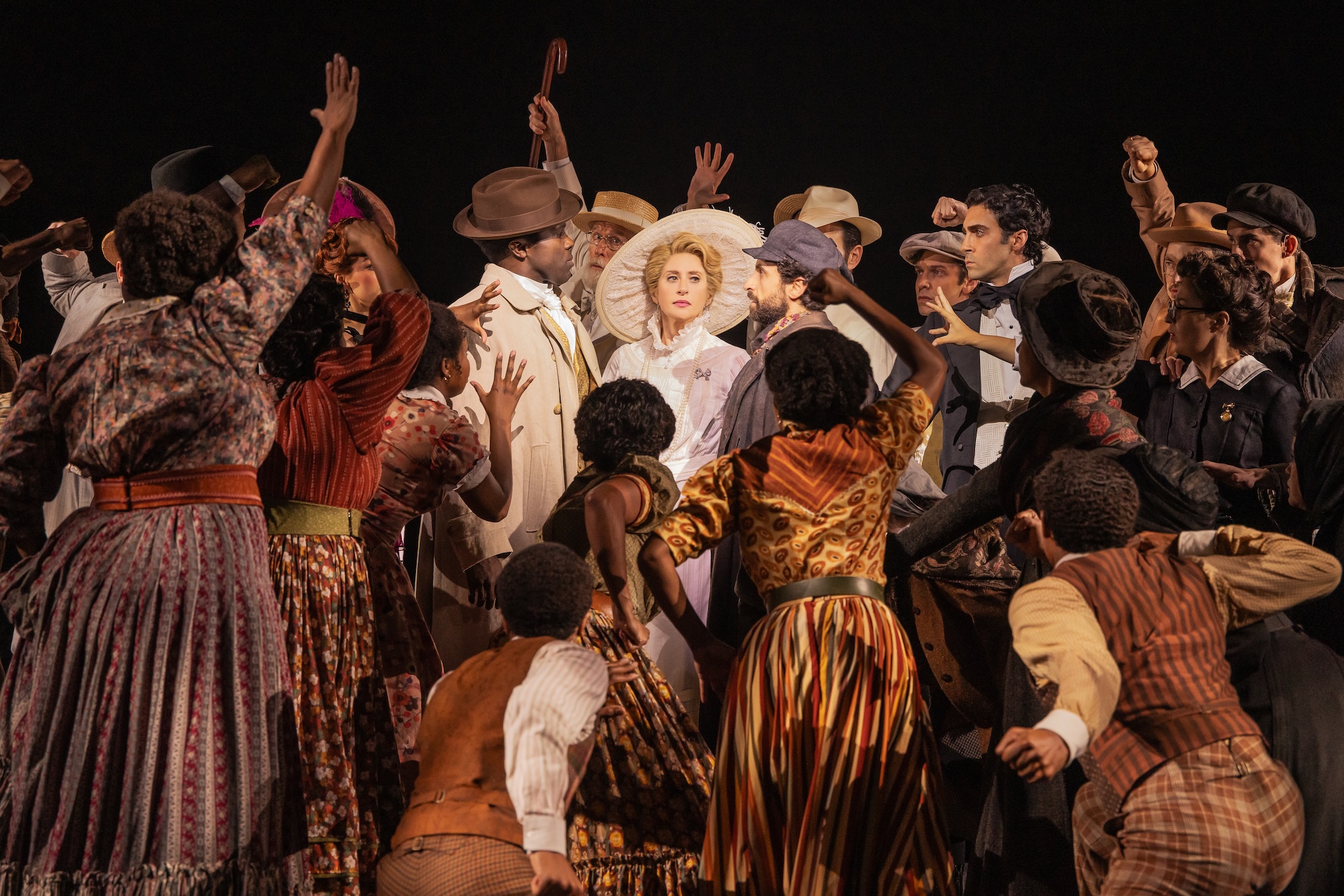
That’s certainly the case with the Tony winner’s latest project: the Broadway revival of Ragtime, which opens October 16 at the Vivian Beaumont Theater. “I think that there’s a curiosity about who we are and the narrative that we tell ourselves about who we are as a country,” he tells Ticketmaster from his dressing room during the musical’s first week of previews. “I feel like we need now more than ever to really take a step back and take stock of how we’ve moved forward as a country and where we’ve stalled. It just feels deeply important right now.”
The much-heralded revival continues Lincoln Center Theater’s triumphant 40th anniversary season after the musical was initially staged at New York City Center last fall for the performing arts center’s annual gala.
For the occasion, the creative team assembled a truly star-spangled cast of Broadway’s crème de la crème, including Joshua Henry as Coalhouse Walker, Jr., Caissie Levy as Mother, Colin Donnell as Father, Nichelle Lewis as Sarah, Ben Levi Ross as Mother’s Younger Brother and Shaina Taub as Emma Goldman — all of whom are joining Uranowitz on stage for what will be the first Broadway production of Ragtime in more than 15 years.
Based on E. L. Doctorow’s sweeping 1975 novel, Ragtime first premiered on Broadway in January 1998, christening the then-newly opened Ford Center for the Performing Arts (now the Lyric Theatre). Starring the likes of Brian Stokes Mitchell, Audra McDonald and Marin Mazzie, the historical drama anchored the Broadway season opposite fellow behemoth The Lion King and ultimately took home four Tony Awards and five Drama Desk Awards out of more than two dozen total nominations. A little over a decade later, the show was revived for the first time for a brief run of just 28 previews and 65 performances from October 2009 to January 2010.
However, Uranowitz’s history with Ragtime goes back even further than the musical’s initial bow on Broadway. In fact, at just 11 years old, the future four-time Tony nominee played The Little Boy in the 1997 world premiere production of Ragtime in Toronto before it made its way to New York City.
At the time, performing alongside Broadway powerhouses like McDonald, Mitchell and Mazzie (as well as fellow child star Lea Michele, who played The Little Girl) was exhilarating for the prepubescent Uranowitz, even if the show’s lofty themes and historical sweep went a bit over his head.
“I just knew that it was about the fight for the American Dream, and what it meant to be an American,” he says, while also acknowledging in retrospect that portraying a “WASP-y… rich white kid” from the upper crust of New Rochelle was intrinsically at odds with his growing understanding at the time of his identity as a young Jewish boy from a family of immigrants.
Nearly thirty years later, Uranowitz is headlining the revival as Tateh, a Jewish artist fleeing persecution in his native Latvia for the promise and freedom of America. Originated by Peter Friedman in the original Broadway production, the character stands in for the millions of immigrants who came to America in the early 20th century — and continue to do so in the present day — with dreams of a better life.
It’s a story that has remained powerful and prescient across the decades — both on stage and in real life. After all, as the entire cast sings in the closing moments of the prologue, “It was the music of something beginning/ An era exploding, a century spinning/ In riches and rags and in rhythm and rhyme/ The people called it Ragtime.”
Below, Uranowitz opens up to Ticketmaster about returning to Ragtime, his thoughts on the pursuit of the American Dream and why he feels the show’s message of hope and community are more urgently needed than ever.
Congratulations on bringing Ragtime back to Broadway! How are previews going so far?
Thank you! It’s been… spectacular. It’s been really great. You know, we’re still in the tech process and doing tweaks. We’re still working and finessing, but audiences have been sort of rapturous and incredible, and the response has been really wonderful. It’s been a really special week of shows.
What drew you to this production of Ragtime?
There are so many reasons. Besides having a very long, personal history with the show, it is really, truly one of my favorite scores ever written, and one of my favorite books. I just think Terrence [McNally] and Lynn [Ahrens] and Steve [Flaherty] did a magnificent job of capturing a very distinctly American experience. I do feel a sense of — and I mean this, I think a lot of folks say things like this when they do a revival of something — but I do feel that there is genuinely an urgency to telling this story right now. And sort of forcing ourselves to look in the mirror, as trite as that may sound, because I know it’s said a lot. But I do think at this particular moment in our country, it feels very important to be telling a story that engenders some sense of hope and that engenders self-reflection.
I’m so curious, especially doing this show right now, about the questions that people walk away with and not necessarily the answers that we give them. I think that there’s a curiosity about who we are and the narrative that we tell ourselves about who we are as a country. And my hope is that this show — because of the period in which it takes place… but mounting it now in 2025 — I feel like we need now more than ever to really take a step back and take stock of how we’ve moved forward as a country and where we’ve stalled. It just feels deeply important right now. So when I got the offer, there was no question in my mind. And then we can also get into the fact that I have a personal [connection]. The phrase that I’m using now is, “I’m reclaiming my time with this show.”
Right. So speaking of that, you also played The Little Boy in the world premiere production back in 1997.
I sure did.
This must be such a full circle moment for you.
It is incredibly surreal. The short version of that story is that Paul Dano was the original Little Boy in the world premiere production of Ragtime in Toronto. He left after a couple of months; I replaced him. And then, as an 11-year-old boy who grew up seeing Broadway shows and dreaming of that, they took everyone to Broadway, basically, except for me. And it just… you know, that’s crushing. That was a very traumatic experience for a young kid. Also, especially that I had to leave school, I was away from all of my friends living in a different country for, like, eight months.
So I harbored a lot of… I mean, it was an incredible experience, obviously. How could it not be? But the fallout left a big, sort of open wound that I’m now feeling able to heal in such a meaningful way. Because I was a young Jewish kid who was, like, just starting to grow hair on his legs playing this WASP-y, New Rochelle rich white kid. And now that I’m stepping into a role that feels so authentically me, I feel very, very grateful and lucky to be able to heal in this way. And I didn’t necessarily know that I needed to — it’s something that I started to learn during the City Center run of the show that I’m now continuing to feel as we do this production.
View this post on Instagram
Which parts of the story stood out to you as an 11-year-old? How much of the plot were you processing back then?
The themes themselves were certainly not as clear-cut to me as they are now. Especially now that we’re really living in a sort of neon-colored view of our country with police brutality and immigrants being disappeared and all of those things. Those were not necessarily as starkly defined for me as a child. But I just knew that it was about the fight for the American Dream, and what it meant to be an American.
And because my own identity was being diluted in a way, because of the role that I had to play, I think I sort of had blinders on a little bit, as a child, to the oppression and the suffering of these other groups of people — one of which is, like, my own family. I come from a family of immigrants. But I think I was also protected and sheltered from that. All of the kids in that show were sort of shielded from the tragedy of it.
So, yeah, the specifics of the themes were not necessarily as clear to me as a child. What was clearer to me was, like, the big picture of America and, to use another trite term, the tapestry that makes us who we are. And the sort of melting pot of people. Their experiences, as an adult, are so beautifully and thoughtfully crafted in this show that it’s very clear to me how it relates to the world now and what those themes are. But as a kid, I was like, “This music is great!”
For people who perhaps aren’t as intimately familiar with Ragtime, tell me a little bit about the character you’re playing now and how he fits into that interwoven, patchwork tapestry of America.
The show follows three groups of people, basically: a community of Black folks from Harlem that is sort of tethered to Coalhouse Walker Jr; a group of white, Anglo-Saxon rich folks in New Rochelle that is tethered to the character of Mother; and then there’s a group of Eastern European Jewish immigrants who are tethered to Tateh, who I play. He’s an artist emigrating to America from Latvia. [Tateh] ends up on the Lower East Side, in the tenements, trying to sell his art to make something of himself in America. And he realizes that’s not as simple as it may seem.
But his is the story that I think is really mostly filled with hope. He ultimately makes it. And his journey from Act I to Act II is extremely stark and vast — going from this poor immigrant to a very wealthy man in Hollywood, I’ll just say that. He ends up in Hollywood making silent films at the brink of the film industry, and ultimately ends up achieving that American Dream. But you get to watch him sort of from the pit of despair to the crest of everything that he ever dreamed of.
Which parts of the story stood out to you as an 11-year-old? How much of the plot were you processing back then?
The themes themselves were certainly not as clear-cut to me as they are now. Especially now that we’re really living in a sort of neon-colored view of our country with police brutality and immigrants being disappeared and all of those things. Those were not necessarily as starkly defined for me as a child. But I just knew that it was about the fight for the American Dream, and what it meant to be an American.
And because my own identity was being diluted in a way, because of the role that I had to play, I think I sort of had blinders on a little bit, as a child, to the oppression and the suffering of these other groups of people — one of which is, like, my own family. I come from a family of immigrants. But I think I was also protected and sheltered from that. All of the kids in that show were sort of shielded from the tragedy of it.
So, yeah, the specifics of the themes were not necessarily as clear to me as a child. What was clearer to me was, like, the big picture of America and, to use another trite term, the tapestry that makes us who we are. And the sort of melting pot of people. Their experiences, as an adult, are so beautifully and thoughtfully crafted in this show that it’s very clear to me how it relates to the world now and what those themes are. But as a kid, I was like, “This music is great!”
For people who perhaps aren’t as intimately familiar with Ragtime, tell me a little bit about the character you’re playing now and how he fits into that interwoven, patchwork tapestry of America.
The show follows three groups of people, basically: a community of Black folks from Harlem that is sort of tethered to Coalhouse Walker Jr; a group of white, Anglo-Saxon rich folks in New Rochelle that is tethered to the character of Mother; and then there’s a group of Eastern European Jewish immigrants who are tethered to Tateh, who I play. He’s an artist emigrating to America from Latvia. [Tateh] ends up on the Lower East Side, in the tenements, trying to sell his art to make something of himself in America. And he realizes that’s not as simple as it may seem.
But his is the story that I think is really mostly filled with hope. He ultimately makes it. And his journey from Act I to Act II is extremely stark and vast — going from this poor immigrant to a very wealthy man in Hollywood, I’ll just say that. He ends up in Hollywood making silent films at the brink of the film industry, and ultimately ends up achieving that American Dream. But you get to watch him sort of from the pit of despair to the crest of everything that he ever dreamed of.
He really does, to me, sort of symbolize the epitome of achieving the American Dream and the thing that we all strive for. I have my own personal opinions about the validity of that and the sustainability of that. Especially right now, with what we’re seeing [in the news and in current events around the country]. If we really want to get into the weeds, I feel like the American Dream is very rooted in a capitalist framework.
I also wonder for myself, like, why is that achievable for Tateh and not for Coalhouse and Sarah? Why is something like that? And what does that say about our country? What does that say about capitalism? What does that say about the American Dream? And those are the sorts of questions that I hope people leave with. Because it is hopeful and it is happy — it is a happy ending for him. But it isn’t so happy for others. And I’m very curious about all of that.
That must be such an impactful arc to carry through the show as an actor.
It is. And it’s a fun one to play! Act I for Tateh is extremely emotionally and psychologically and physically painful, and then Act II is full of hope and a bright future. His child is happy and thriving. As an actor, it’s a deeply, deeply satisfying journey to take every night.
You mentioned Ragtime has one of your favorite scores. Do you have a favorite song in the show? Which one means the most to you to perform every night?
It’s an impossible question, it’s like a Sophie’s choice kind of question. I love “Gliding” because… it sort of encapsulates for Tateh that moment between a desperate past and a hopeful, bright future. It’s like right in the center of those two diverging paths, and it’s just so filled with hope. And it’s such a great opportunity for an actor to play positive action.
Then, for selfish reasons, I love singing “Our Children” ’cause I get to sing it with Caissie Levy [who plays Mother]. That happens in Act II when we’re talking about our kids and, you know, I’m just so devastated these days by how divided we have become. And to watch two people from very different backgrounds look at the next generation thriving together is just such a beautiful window into what this country can be and should be and what it’s meant to be. And, I think, what it was intended to be. I think, on its face, “Our Children” can just feel like a beautiful song about parents and their kids, but it just holds so much in it. And it’s such a simple song. It just sort of breaks my heart every night, so I love it. Those are my two, I think, that I love to perform the most. And “Buffalo Nickel” is just, like, so fun.
So the last time you worked with Lincoln Center Theater, you earned Tony and Drama Desk nominations for Falsettos. I saw Floyd Collins earlier this season, and it was actually the first time I’d ever been inside the Beaumont. It’s such a beautiful theater!
Oh my god, right? Well, so, Falsettos was produced by Lincoln Center Theater, but it was at the Walter Kerr, where Hadestown is. So this is my first time in this space, and it is truly, without question, my favorite theater in this city. I’m telling you right now, there is no better theater for Ragtime than the Beaumont. It feels like it was made for this theater, specifically. Because we’re in a thrust, the audience is all around us, but it’s also massive.
Ragtime, to me, is all about panning out and zooming in. Like, that is the entire crux of the show — we pan out and see these epic, epic visions of America and culture and groups of people. And then we zoom in on these very, very small, intimate moments and relationships. And I think there’s no better space than [the Beaumont] ’cause you feel intimate. I can see people’s faces. In those intimate, small moments, I know that we’re sharing it with people. And then we can zoom out and just fill up the entire space. [Director] Lear deBessonet and Ellenore Scott, our choreographer, and our designers are doing such a spectacular job of calibrating how Ragtime goes from the epic to the intimate and how it just is constantly flowing through the course of the show. It’s just a spectacular space.
Since it’s really at the heart of the story Ragtime is telling, what’s your perspective now on the American Dream? How do you define it in 2025?
I think it’s always been a positive thing. It’s just there are too many roadblocks and too many people with myopic, sort of narrow visions — bigoted and all of those adjectives — blocking people from doing that. Since its inception, this country has been and should be a place where you can be who you are, love who you love, do what you want to do. And that, to me, is worth fighting for. I think we sometimes get a little hoodwinked into thinking that fame and fortune is the ultimate goal. But to me, it’s about authenticity: living authentically, being with who you want to be with and having a family that makes sense for you and the people that you love.
So that, to me, is what we are fighting for as a country right now. And that is what this show is meant to inspire in people. That no matter where you come from, no matter where you’re raised, no matter what you look like, you are enough. That, to me, is the American Dream… it’s about being able to live truthfully with your feet planted on the ground without any shackles on you. Living freely and openly and authentically. So if we look at the American Dream in that way, then I think it’s a galvanizing thing. I think it’s a galvanizing way to become engaged in what it means to be American. And I hope this show does that for people. It certainly does for me.
Tags
You Might Like
Arts & Theatre
Ana Gasteyer on Her Schmigadoon! Broadway Role: “I Could Do This Forever”
Ana Gasteyer knows a thing or two about being funny. But the comedian’s love for Broadway is anything but a joke. Known to generations of fans as, alternatel...
Arts & Theatre
New to Broadway? Here’s a Handy Beginner’s Guide
You only get one first Broadway show. So how do you choose? Every theater fan remembers their first experience. Whether it was a musical staged in your homet...
Arts & Theatre
The Lost Boys’ Cast & Crew on Telling a “Human Story“ with Vampires
Michael Arden considers himself a “baby vampire.” After all, before the acclaimed director was approached to helm the new Broadway adaptation of The Lost Boy...