


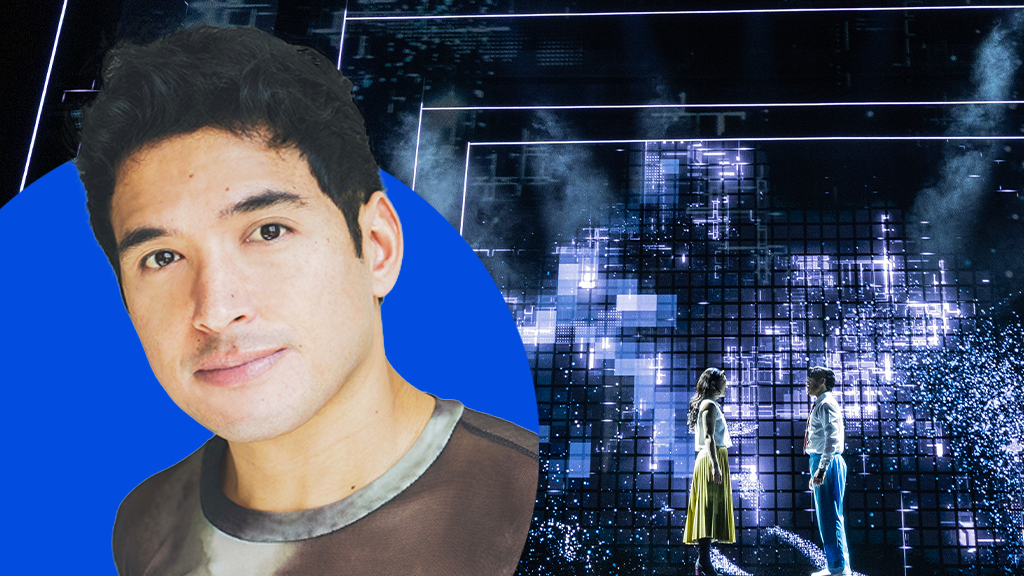
Consider Zachary Noah Piser the original prototype for the Helperbots of Maybe Happy Ending. After all, long before the one-of-a-kind musical became a Tony-winning sensation on Broadway, the Chinese-American actor played Oliver—the vintage Helperbot-3 living out the rest of his battery life in a Seoul retirement facility for old-model robots—in one of the show’s earliest workshops.
Now, four years and six Tony Awards for the show later (including one for Best Musical), Piser is stepping back into Oliver’s jazz-loving shoes to headline Maybe Happy Ending at the Belasco Theatre. “When this came back around, it was not on my bingo card in any way,” he admits, sitting down with Ticketmaster inside the Oak Room of the historic Algonquin Hotel—yes, the same Beaux Arts building in Midtown Manhattan where Lerner and Loewe famously wrote a little musical called My Fair Lady.
On the rainy day we met, the entire cast and creative team had come together at the Algonquin to celebrate the casting of Piser and Hannah Kevitt, who’s been promoted from standby for Claire to the show’s official leading lady. With Oliver’s beloved potted plant HwaBoon looking on proudly from atop the grand piano, Piser, Kevitt and longtime cast members Marcus Choi and Dez Duron regaled the intimate crowd of journalists and influencers with acoustic renditions of “Where You Belong,” “The Rainy Day We Met” and “Then I Can Let You Go.”
And there was even more exciting news to announce to the room: Not only is Maybe Happy Ending officially extending its run through February 28, 2027, but as of July 7, the heartfelt musical all the way from Korea has—with a battery life of 688 shows and counting—become the longest-running show in the history of the Belasco Theatre.
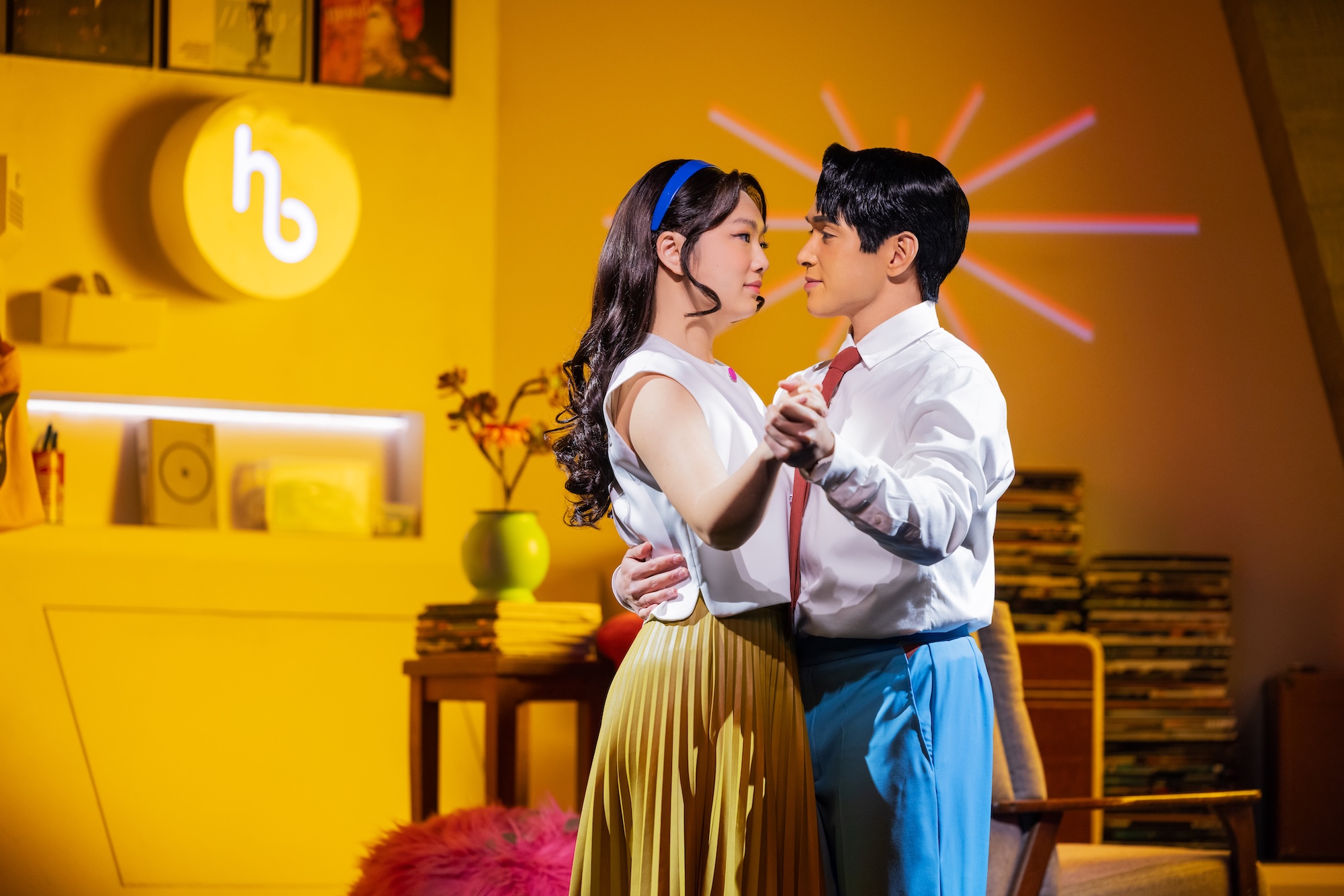
For Piser, whose resume boasts stints in Wicked, Dear Evan Hansen and the original Broadway casts of KPOP and Redwood, the opportunity to come back to Maybe Happy Ending during such a historic run marks the kind of full-circle moment that’s increasingly rare in the theater industry.
“Like, I’m not even having humility, I really didn’t think that this would happen,” he says. “Every single day that I start the show, I always take a little giddy breath right before because I can’t believe that the person who did a workshop four years ago—which I was like a completely different person then, literally!—gets to do it now. It’s really very special, I’m really happy.”
Below, Piser opens up to Ticketmaster about what makes his “neurotic” version of Oliver unique, the importance of Asian representation on the Broadway stage, how roles in Dear Evan Hansen and KPOP helped prepare him to play Oliver, what he learned from working with Idina Menzel in Redwood and more.
So I normally like to start these conversations by asking what drew an actor to a particular show, but I didn’t realize you have a history with Maybe Happy Ending!
Yeah! So, around the time I was doing Dear Evan Hansen, I was doing a play at Williamstown Theatre Festival, and that’s where I met [Maybe Happy Ending director] Michael [Arden]. It was our first time meeting, and he was like, “I think you’d be really right for this role, we’re deciding if we want to bring it to New York, it’s been in Korea. We’ll be in touch.” And, you know, you hear that all the time, but then he actually did get in touch. Then, in 2022, I was doing Evan Hansen with very little time on my hands, but I was like, “Anything Michael does, of course!” I did a big workshop of the show, and then a couple years passed, the options dropped, they had new producers come on board. And it was the same season I did Redwood with Idina [Menzel]. And the moment when Mother calls, I was like, “Yeah!”
So when this came back around, it was not on my bingo card in any way. Like, I’m not even having humility, I really didn’t think that this would happen. And so when it did, especially with a show like this that exists because people love it, because it is so goddamn good, it’s original, it is beautiful, it’s simple, it’s heartbreaking, it’s unexpected—to step into it and lead this show…it’s like, every single day that I start the show, I always take a little giddy breath right before because I can’t believe that the person who did a workshop four years ago—which I was like a completely different person then, literally!—gets to do it now. It’s really very special, I’m really happy.
@maybehappyendingbway On replay tbh 🔁 @zach_piser and @hannah.kevitt perform “Rainy Day We Met” at the @algonquinnyc 🎥: @primmecreative #maybehappyending #broadway #musicaltheatre #maybehappyending🤖
Along with that, it should be said that replacing is one of the unsung parts of Broadway. What are some of the opportunities versus the challenges that come with replacing? Especially for a role like Oliver, that’s become so well-known now.
Yes. So the thing is, [this] not my first time replacing. I replaced in Wicked, I replaced with Dear Evan Hansen. But this show has been very special in terms of replacing because I know the creative team, I’ve worked with them in previous ways. So my very first day in rehearsal, I was like, “OK, just give it to me straight: is this like Wicked?” Where it’s like, cookie cutter, just gotta go and hit all the marks. I did Boq for two years [with]…not no creative expression, but, you know, it’s been running for 25 years. Do the show. “Or is it like, you’re the first permanent replacement, I have a little more leeway and freedom?” And they were like, “That one.” Which, to me, I didn’t know going into the room.
But that has been such a gift to be told that. Of course you’ve gotta hit your light. You’ve gotta sing the notes. Say the words. And have the intention that they have at least written in and created as the creative team. But I had four weeks of rehearsal and Will Aronson, one of the creators of the show, and Michael were in the room for a lot of the rehearsals. Which allowed those kinds of conversations that almost felt like it was not just Project: Get Zach Into the Show but, like, Project: Help Zach Develop His Version of Oliver. Which will forever continue to be developing with a role of this magnitude.
That was an extra gift on top of the gift of getting the job, to be able to not be confined to, “You have to do every physicality that Darren [Criss] did or every single moment or beat.” They’ve really let me, within reason, take some really nice liberties of what my understanding of the character is. Because with replacing, it’s always a tricky thing. ‘Cause yes it’s the same role, but everybody is so different. And Darren—love him, like, so sweet—we are just very different humans. So inevitably our interpretations are gonna be different, and they have really allowed me to explore that…They allowed me to bring a lot of myself to it, which doesn’t always happen. Especially with leading roles, where they’re like, “Just learn it and just do it.”
How would you describe your version of Oliver?
I like to lean more into the neurotic agoraphobe hermit that he is in the beginning of the show—where he doesn’t like to go outside his room, he doesn’t like anyone coming into his room, all that he cares about is James. Which I think allows us to have much more of a flourish throughout the show when he is unexpectedly intrigued by these things that he thought were scary. Of, like, going outside of his room, going and seeing a motel room, going and seeing the fireflies. At the beginning of the show, if you asked my version of Oliver, “Would you go do that?” He’d be like, “Nope! I’m gonna stay right here with HwaBoon and we’re good.”
And doing it with Hannah [Kevitt], who is such an open heart, open soul—our Oliver and Claire feel really softer. Especially at the end. Like, more intimate and gentle. Not in a, like, gross way, but there’s a real sweetness to it that I really, really love.
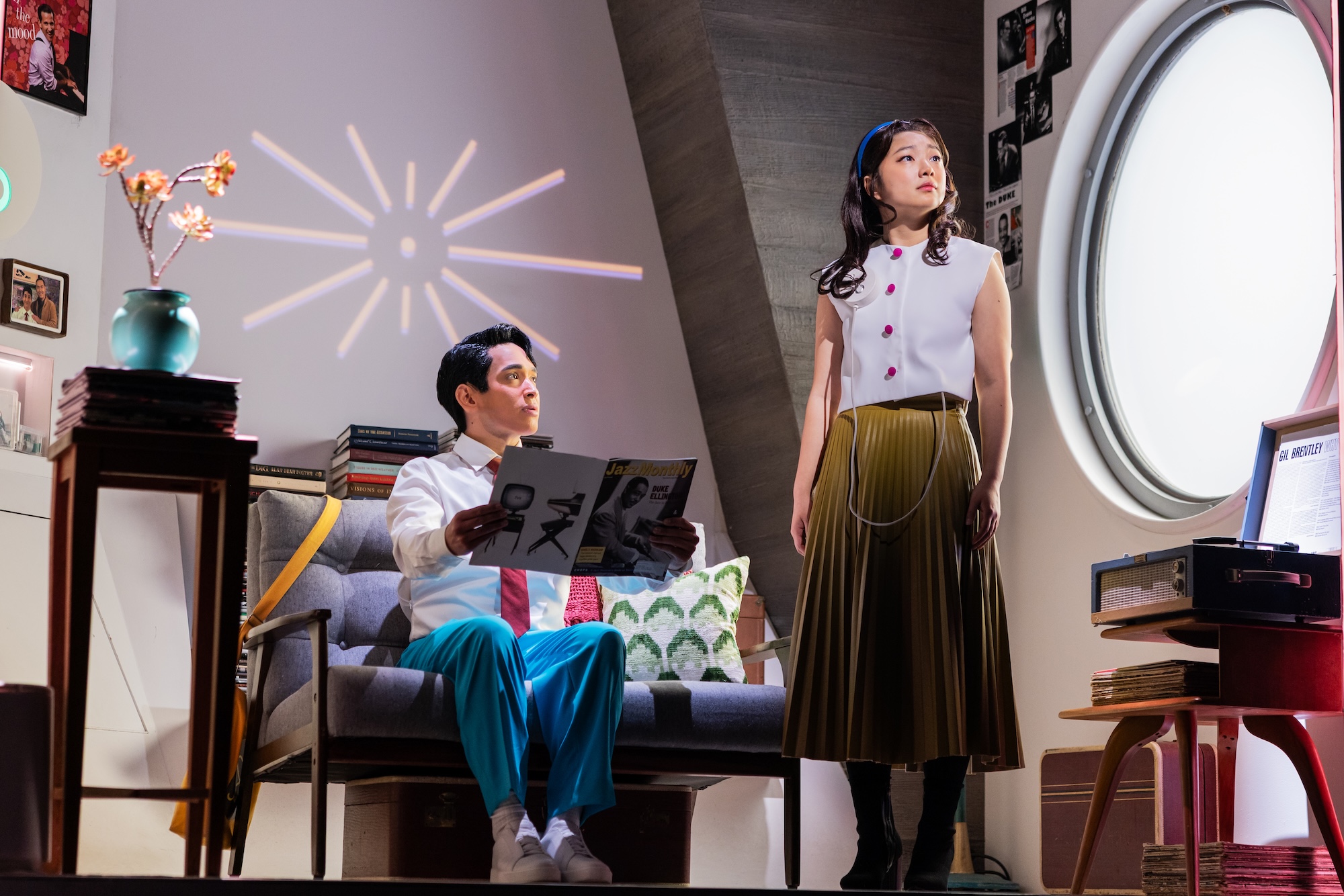
You made history as the first Asian-American actor to play Evan Hansen. You also starred in the original Broadway cast of KPOP, now you’re leading Maybe Happy Ending. As an Asian-American actor, what does it mean to you to represent for your community and your culture?
That’s a great question. When I came to the city almost 10 years ago, people were like, “You’re ethnically ambiguous, you can be whatever you want!” And I was like, “But I don’t wanna be, I’m half Chinese and full Jewish, that’s what I am!” But it was a very different time, right? Even then, it was like the end of the peak of “ethnically ambiguous,” whatever that means. And this show is different from the other Asian shows that I’ve done. I did an Asian version of See What I Wanna See downtown with Out of the Box Theatrics. I did KPOP. Those shows were beautiful and incredible for so many different reasons, and commercially had a hard time. As every show is wont to do, but it was hard. And it was one of those things where, what’s the lesson we’re taking away for it? Is it that Asian people can’t sell a show? Is it that the public doesn’t like Asian people? I don’t think it’s that, but it’s like…what is it? It was honestly a genuine question.
So with this show, seeing it be so commercially successful and then getting to be a part of it, and to lead it and have it be my face outside the Belasco Theatre…I wouldn’t say I prefer one experience over the other, because I learned so much by doing KPOP, so much by doing See What I Wanna See. You really learn what kind of artist you are when you’re, like, doing a show full-out for 14 people in an audience. Versus here, where we’re selling out. It makes me appreciate both so much more being on either end. To see the pros and cons and to just be particularly grateful that this show is Asian-centric and is successful.
I have to say, I saw KPOP in maybe the last week of its run, and if you weren’t inside that theater, you don’t get it.
Exactly! Totally. ‘Cause it was definitely an experience of its own. That was one of those things where it’s like, especially with K-Pop Demon Hunters, I’m so curious if it opened now, what would happen. It was too early. And also, ‘member COVID? It was like, Omicron had just hit, so people were [scared]. It was not the best timing. But also, if I’ve learned anything being in the industry for almost 10 years, it’s that there is never the right timing. You just kind of guess and you go for it. Like again, me being here, I would’ve never guessed. Even if I had planned it, it would never have happened, you know?
You also mentioned doing Redwood with Idina. What did you learn from her and that experience? Because it was a show that didn’t get to live for very long…
Idina Menzel is the most present actor I’ve ever met in my life. And that comes with all the territory. Like, there was a day where she forgot a line and we just improvised onstage for what felt like 10 minutes to me, but was probably a minute and a half. But she’s so present, she literally is always looking you in the eye and is always serving up new things that inspire me and my art.
You know, when you first come to the city, like when I did Wicked—and this is not a s–t on Wicked, by the way—but just like, earlier in your career, you’re encouraged to do the job, be consistent, let that be your thing. And she was a great example to me of someone who’s made a career of being so authentically herself. And a part of that is how present she is in whatever moves her in the day, in the moment. And I was like, “Oop, I’m taking that with me. And if someone says that that’s not allowed, I’ll be like, ‘But Idina…’ I’ll be like, [mimics picking up a phone], “Mommy? Idina? What do you think about that?'” I’m trying to get her to come see the show, she’s just never here.
Coming back to Maybe Happy Ending, there’s also been a lot of conversation around this show about the importance of Asian representation in the casting. Do you have any thoughts on that?
So, when I first came to the show, my first question to the creative team was, like, “Talk to me about this replacement. Do I get creativity?” The next follow-up conversation I had was, “What is your dream? You wrote this. What is your vision for this show?” ‘Cause I wasn’t a part of the show when Andrew [Barth Feldman] was going in the show. And I know Andrew very well, we worked on Evan Hansen together, but I wasn’t really in the world of [Maybe Happy Ending] once we separated in 2022.
So I was like, “I would love to hear from the horse’s mouth.” It’s always better that way, right? So I had a conversation with our creative team. Will is American, Hue [Park] is Korean—they both are bilingual, they both speak English and Korean. They met here in New York, they went to Korea, wrote this musical, it’s beloved there and brought it here. And their vision was, ultimately, that James, the role that Marcus [Choi] plays, is a character that is not only Asian, but needs to be Korean. He needs to be played by a Korean actor because it is set in Seoul. He lives there.
So then, elephant in the room: what about the robots? And they were like, “Our intention was never to be strictly Asian with the robots.” So hearing from them that they were like, “Our dream for this show is that hopefully the robots can have more limitless potential of what they can be,” my response was like, “I’m very curious about what that looks like.” If there was a Latino Oliver. If there was a Black Claire. If there was a trans [Helperbot]…like, any kind of actor, body, color stepping into these roles, I’m curious about that. To see, would it actually change the story? Or is the material about something bigger than that? Is it about mortality and life that kind of transcends that? It’s one of those things where I’d have to see it and, like, be in it and doing it to know how I felt.
@maybehappyendingbway @zach_piser & @hannah.kevitt are THE dynamic duo 💜 Come catch them as Oliver & Claire in Maybe Happy Ending on Broadway #maybehappyending #broadway #musicaltheatre #maybehappyending🤖
Another thing that makes Maybe Happy Ending feel so special is that it’s really developed its own unique fan culture—Helperbots, fireflies, HwaBoon, all of it. How do you feel stepping into that ecosystem with such a passionate fandom?
Well, hilariously, I’m Chinese, so I’m not Korean. And in KPOP, I played the one mixed-race Asian, you know, Chinese and American person infiltrating the Korean space. But doing KPOP was such a crash course for me of, like, Korean culture in a way that I had never experienced before. I mean, we live in New York and I grew up in the Bay Area, so Asian people were everywhere. But I had a crash course of, like, food, family, culture, life.
And so I think stepping into this show, which is obviously very different in terms of how integral Korean culture is to the show, I definitely feel less of an imposter because, I think, of my history and my knowledge of Korean culture. But also, I feel like I do my best work when I’m curious and open to learning new things. And this show, even though I was a part of it four years ago…do you remember what you were doing four years ago? I certainly do not. They were like, “Great, so you’ll need a couple days with the music?” [Laughs] I was like, “I need a week and a half for everything.” But yeah, that’s a great question. I loved what you said about how it’s obviously got Korean bits and Korean writing, but then there’s also a sub-sect of the culture that specifically Maybe Happy Ending has created, like Helperbots, futuristic fireflies. Like, how special is the show that it can touch upon so many specific things but then also can be so universal and create its own language? Pretty f—-g cool.
Buy Maybe Happy Ending tickets on Broadway and other tickets for Broadway via Ticketmaster.
Tags
You Might Like
Arts & Theatre
Step Inside Lunt-Fontanne Theatre, The Holiday Home of Blue Man Group
Update (October 22): This article has been updated with the latest info about the Lunt-Fontanne Theatre. The Lunt-Fontanne Theatre opened in 1910 as the Glob...
Arts & Theatre
Much Ado About Nothing’s Mason Alexander Park Shares Pre-Show Playlist
Mason Alexander Park will always associate Shakespeare with Coldplay. After all, the actor’s time spent in London starring in the new revival of Much Ado Abo...
Arts & Theatre
Broadway Ticket Deals: Current Discounts on Broadway Shows in NYC
Broadway is calling! For theater fans looking to experience the best of New York City’s legendary stages without paying full price, this is your destination ...